As we promised in part8 of this series, In this post we are going to see few sample outputs from Tower4 program in action. Also we will discuss the algorithm behind how to determine the best breakdown of middle towers. (Remember, in four tower case, we have choices on how to distribute the disks between tower 2 and 3 when we want to move disks from tower 1 to 4)
Let's see the case of 5 disks :
6,5,4,3,2, : : 1, :
6,5,4,3, : : 1, : 2,
6,5,4, : 3, : 1, : 2,
6,5,4, : 3,2, : 1, :
6,5,4, : 3,2,1, : :
6,5, : 3,2,1, : : 4,
6, : 3,2,1, : 5, : 4,
6, : 3,2,1, : 5,4, :
: 3,2,1, : 5,4, : 6,
4, : 3,2,1, : 5, : 6,
4, : 3,2,1, : : 6,5,
: 3,2,1, : : 6,5,4,
: 3,2, : 1, : 6,5,4,
2, : 3, : 1, : 6,5,4,
2, : : 1, : 6,5,4,3,
: : 1, : 6,5,4,3,2,
: : : 6,5,4,3,2,1,
17 Moves
If we look at step 8 above (in blue), we will see that the program has distributed top 5 disks as 3 : 2 in the middle 2 towers. It has then moved the 6th disk to 4th tower. It could have distributed them as 4 : 1, but has found that it will be more costly. Mini tower 3-2-1 it has created on tower2 was created using all 4 towers but the Mini tower it has created on tower3 (which has disks 4 and 5) was created using only 3 towers while keeping the already buildup content at tower 2 intact.
Once the biggest disk (disk 6) was moved to tower 4, program has created a mini tower 4-5 at top of tower4 while keeping tower 2 intact. After that step it has created a mini tower 3-2-1 on tower4 using all 4 towers.
Let's have a good look at again and make sure we understand the process!
In general, to solve 4 tower case for n disks, we need to follow these steps :
1) find optimal numbers for x and y such that x+y=n-1
2) build a tower of hight x in tower2 using all 4 towers
3) build a tower of height y (starting from disk x+1) in tower3 while using only 3 towers (since the content we built on tower2 need to be preserved)
4) move the largest disk (which is n) from tower 1 to tower4
5) build a tower of height y on top of tower4 (starting from disk x+1) while using only 3 towers and keeping the content on tower2 intact.
6) build a tower of height x in tower4 using all 4 towers.
Above is a recursive algorithm because to build a tower of n using all 4 towers, we will have to build a tower of x using all 4 towers!
Now, only one problem remaining.
How to decide on the best distribution between tower2 and 3 (in the example it was 3:2 and not 4:1), that is x was 3 and y was 2 how to find x and y ?
Here too we could use recursion!
Following recursive algorithm and the program is something I have come up with and haven't seen in anywhere else yet. If any of you find a similar algorithm or a better one to solve this puzzle please inform me by putting a comment here with your finding. The code for this will appear in the next post
We need some notations here to make things clearer :
Let T4(n) = 'steps to make a tower of height n using 4 towers'
Let T3(n) = 'steps to make a tower of height n using 3 towers'
Then we can express the steps needed for above 6 steps in this form :
T4(n) = 2*(T4(x)+T3(y)) +1
For instance, T4(6) = 2* (T4(3)+T3(2)) + 1
but we know T3(m) is 2m-1, hence T3(2) above is 22-1 = 3
So, T4(6) = 2*T4(3)+7
To build a tower of height 1, we need just 1 step.
According to above algorithm (steps 1 to 6 given above), building a tower of 2 will need 3 steps, since n=2, x=1 and y=0 in this case. (you can work out how we arrived at number 3 as home work!)
Now that we know steps needed to build a tower of 1 and a tower of 2, can we find the steps needed to create a tower of 3 ?
We have 2 choices
n =3, x=1,y=1 and
n=3, x=2, y=0
In the first case, steps needed will be 5. (home work for readers) In the second, it will be 7! (more home work) So we go with option 1. That means T4(3) =5 !!
Now we could revisit the problem of T4(6).
Earlier we found T4(6) = 2 * T4(3) + 7
then T4(6) = 2*5 + 7 = 17 Which is exactly the number of steps our program has taken to solve!
So we could recursively find best x and y for any n
All we need now is to write the nice recursive code. We will give the readers few days to come up with that code before unraveling it in our last post of Towers Hanoi series.
After that we will move to a new game and a new problem !
Your feedback on the Hanoi Towers series so far will be greatly welcome!
Showing posts with label algorithm. Show all posts
Showing posts with label algorithm. Show all posts
Friday, April 29, 2011

Thursday, April 14, 2011
Towers of Hanoi - part 8
In the earlier post, we learned that still, (surprisingly) there is no mathematical formula for the minimum number of steps needed to solve a Tower of Hanoi puzzle where there can be towers more than 3 and any number of rings. That is no formula exists which gives the number of steps as a function of rings and towers.
In this post, we will do away with mathematical aspects of this puzzle and focus on what we know better. Yea, the algorithm!
Suppose we have 10 rings (all in the 1st tower) there are 4 towers and you want to move all to the 4th tower.
1) We have to place first 9 rings in the 2 middle towers (tower2 and tower3).
2) Move the 10th towers from tower 1 to tower 4
3) build a tower of 9 in tower4 by using the rings in 2 middle towers.
This will lead to a recursive algorithm. Trick is to get the step 1 above right, how best to distribute the first 9 rings among two middle towers ?
What I did was to write a separate method to determine just that! In that method I will calculate steps needed achieve to each of different distribution of 9 rings. Distributions goes like this :
tower2 have first 8 rings, tower 3 have the ring 9 Or
tower2 have first 6 rings, tower 3 has 7 to 9
tower2 have first 5, tower 3 has 6 to 9
and so on....
So my method will calculate steps needed to create each of that distribution and then find the distribution which will need the least number of steps to create. Once we know that, we just call our recursion function to build towers. For instance, if the best configuration is 1-6 in tower2 and 7-9 in tower3, our recursive function will look like this.
buildtower4(tower1,tower2,tower3,tower4,6) // use all 4 towers and build a tower of 1-6 in tower2)
buildtower3(tower1,tower4,tower3,9,7) // use only the give 3 towers and create a tower with rings 9 to 7 in the third tower)
moveRing(tower1, 10, tower4) // ok, we created the optimal distribution of first 9 rings, now move the 10th ring to final destination)
buildTower3(tower3,tower1,tower4,9,7) // build a tower of 9-7 in tower4. don't touch tower2)
buildTower4(tower1,tower4,tower2,tower3,6) // use all 4 towers and build a tower of 1-6 on top of tower4
Implement something like that in any language and you will have a working code which solves the 4 tower puzzle!
Now, 3 challenges from today's post :
1) Write the algorithm to determine the optimal combination to distribute N rings in the two middle towers.
2) Implement that algorithm in code.
3) implement the given algorithm today to solve the 4 tower puzzle once and for all!
In the next post we will see few sample outputs from my code... and few screen shots to ram in what we discussed today, for those who have already got the message from today's post, good luck with the code!
See you soon.....
In this post, we will do away with mathematical aspects of this puzzle and focus on what we know better. Yea, the algorithm!
Suppose we have 10 rings (all in the 1st tower) there are 4 towers and you want to move all to the 4th tower.
1) We have to place first 9 rings in the 2 middle towers (tower2 and tower3).
2) Move the 10th towers from tower 1 to tower 4
3) build a tower of 9 in tower4 by using the rings in 2 middle towers.
This will lead to a recursive algorithm. Trick is to get the step 1 above right, how best to distribute the first 9 rings among two middle towers ?
What I did was to write a separate method to determine just that! In that method I will calculate steps needed achieve to each of different distribution of 9 rings. Distributions goes like this :
tower2 have first 8 rings, tower 3 have the ring 9 Or
tower2 have first 6 rings, tower 3 has 7 to 9
tower2 have first 5, tower 3 has 6 to 9
and so on....
So my method will calculate steps needed to create each of that distribution and then find the distribution which will need the least number of steps to create. Once we know that, we just call our recursion function to build towers. For instance, if the best configuration is 1-6 in tower2 and 7-9 in tower3, our recursive function will look like this.
buildtower4(tower1,tower2,tower3,tower4,6) // use all 4 towers and build a tower of 1-6 in tower2)
buildtower3(tower1,tower4,tower3,9,7) // use only the give 3 towers and create a tower with rings 9 to 7 in the third tower)
moveRing(tower1, 10, tower4) // ok, we created the optimal distribution of first 9 rings, now move the 10th ring to final destination)
buildTower3(tower3,tower1,tower4,9,7) // build a tower of 9-7 in tower4. don't touch tower2)
buildTower4(tower1,tower4,tower2,tower3,6) // use all 4 towers and build a tower of 1-6 on top of tower4
Implement something like that in any language and you will have a working code which solves the 4 tower puzzle!
Now, 3 challenges from today's post :
1) Write the algorithm to determine the optimal combination to distribute N rings in the two middle towers.
2) Implement that algorithm in code.
3) implement the given algorithm today to solve the 4 tower puzzle once and for all!
In the next post we will see few sample outputs from my code... and few screen shots to ram in what we discussed today, for those who have already got the message from today's post, good luck with the code!
See you soon.....
Tuesday, March 8, 2011
Bringing Down Towers of Hanoi - part7
In last post, we planned to discuss more about the problem of multi towers in hanoi and give some hints on the algorithm.
Interestingly, for multiple towers, no one has still come up with a general formula to express the number of steps as a function of number of towers and number of rings. Some general cases have been figured out though. For instance, we don't need to be mathematicians to say whats the number of steps would be for a problem with more towers than there are rings. Say, 11 towers and only 10 rings! what would be the number of steps to solve this ?
Of course, it would take 9 steps to remove top 9 rings into 9 different towers. Then 10 steps to put all rings in the target tower. 19 steps in all. In other words, 2n-1 ! However, people have found that coming up with a general formula when the number of rings are greater than number of towers (which is greater than 3) is little bit harder than that.
In an earlier post we have seen it takes exactly 2n-1 to solve the 3 tower case (worse case) for n rings.
We have just saw that it takes 2n-1 to solve the m tower case for n rings where m > n (best case)
What happens when m =n, Here is my result. I will intentionally leave out the explanations so you can arrive at that independently.
When m = n, it takes (n-1) + 1 + (n-2) + 3 = 2n+1 steps to solve the puzzle!
Similarly, when m = n-1, it becomes 2n+3
It appears like we could express number of steps as (2n-1) + 2*(n-(m+1)) = 4n - 2m + 1
However, these are true only when number of towers are closer to number of rings. When number of towers become less compared to number of rigs, it get complicated. Say, 10 rings in 4 towers. However, solving such a puzzle manually is much easier (in terms of number of steps needed) than solving a similar number of rings with 3 towers. Problem is when we try to find the optimal strategy.
I could display few graphical outputs from the program I currently have but before that, wouldn't you want to give it a try yourself ? Remember, number of steps needed is drastically reduced now. We will still need a recursive solution as the nature of the problem commands....
Interestingly, for multiple towers, no one has still come up with a general formula to express the number of steps as a function of number of towers and number of rings. Some general cases have been figured out though. For instance, we don't need to be mathematicians to say whats the number of steps would be for a problem with more towers than there are rings. Say, 11 towers and only 10 rings! what would be the number of steps to solve this ?
Of course, it would take 9 steps to remove top 9 rings into 9 different towers. Then 10 steps to put all rings in the target tower. 19 steps in all. In other words, 2n-1 ! However, people have found that coming up with a general formula when the number of rings are greater than number of towers (which is greater than 3) is little bit harder than that.
In an earlier post we have seen it takes exactly 2n-1 to solve the 3 tower case (worse case) for n rings.
We have just saw that it takes 2n-1 to solve the m tower case for n rings where m > n (best case)
What happens when m =n, Here is my result. I will intentionally leave out the explanations so you can arrive at that independently.
When m = n, it takes (n-1) + 1 + (n-2) + 3 = 2n+1 steps to solve the puzzle!
Similarly, when m = n-1, it becomes 2n+3
It appears like we could express number of steps as (2n-1) + 2*(n-(m+1)) = 4n - 2m + 1
However, these are true only when number of towers are closer to number of rings. When number of towers become less compared to number of rigs, it get complicated. Say, 10 rings in 4 towers. However, solving such a puzzle manually is much easier (in terms of number of steps needed) than solving a similar number of rings with 3 towers. Problem is when we try to find the optimal strategy.
I could display few graphical outputs from the program I currently have but before that, wouldn't you want to give it a try yourself ? Remember, number of steps needed is drastically reduced now. We will still need a recursive solution as the nature of the problem commands....
Sunday, February 27, 2011
Bringing Down Towers of Hanoi - part6
Today, we are going to see the magic code which solves Towers of Hanoi General Problem. Those who still (bravely) want to give it an own try before looking at the code. Can go through these hints and do so.
Before going to the code, I have something else to show you. This mathematical proof I found from web, which basically gives a formula for the average number of steps for the general case.

wow, that's some formula for you!
Anyway, as you can see, the code below is the simplicity itself! The solution we propose is bounded by 2n-1, and never exceeds that, also when we present a half done problem, it actually solves it optimally. When you look at the code you get the intuitive feeling that this has to be the optimal solution, wish we could device a mathematical proof too for that fact!
private static void buildTower(int height, ArrayList source,
ArrayList target, ArrayList middle) {
if (height < 0) {
return;
}
if (target.contains(Integer.valueOf(height))) {
buildTower(height -1, source, target, middle);
} else {
if (middle.contains(Integer.valueOf(height))) {
ArrayList temp = middle;
middle = source;
source = temp;
}
buildTower(height-1, source, middle, target);
move(source, target);
print();
buildTower(height-1, middle, target, source);
}
}
Bolded are the lines we added to the last solution. (specific case where all rings are in first tower at the beginning.) Now, isn't this simple ?
One more thing : I havn't yet seen this code (or the algorithm) anywhere in the internet. If some one come across this in anywhere else, please post a comment with the link.
In next post, we will discuss few hints on how to solve the 4 tower case.
Have a nice day!
Before going to the code, I have something else to show you. This mathematical proof I found from web, which basically gives a formula for the average number of steps for the general case.
wow, that's some formula for you!
Anyway, as you can see, the code below is the simplicity itself! The solution we propose is bounded by 2n-1, and never exceeds that, also when we present a half done problem, it actually solves it optimally. When you look at the code you get the intuitive feeling that this has to be the optimal solution, wish we could device a mathematical proof too for that fact!
private static void buildTower(int height, ArrayList
ArrayList
if (height < 0) {
return;
}
if (target.contains(Integer.valueOf(height))) {
buildTower(height -1, source, target, middle);
} else {
if (middle.contains(Integer.valueOf(height))) {
ArrayList
middle = source;
source = temp;
}
buildTower(height-1, source, middle, target);
move(source, target);
print();
buildTower(height-1, middle, target, source);
}
}
Bolded are the lines we added to the last solution. (specific case where all rings are in first tower at the beginning.) Now, isn't this simple ?
One more thing : I havn't yet seen this code (or the algorithm) anywhere in the internet. If some one come across this in anywhere else, please post a comment with the link.
In next post, we will discuss few hints on how to solve the 4 tower case.
Have a nice day!
Tuesday, February 22, 2011
Bringing Down Towers of Hanoi - part2
Ok, Here we would discuss the solution and the code to implement it for our little tower puzzle. Those who are new to the series or those who like to give one last try at the puzzle before looking at the answer. Can do so by going back to part1.
Let's imagine we have a simple tower of 5 rings.
 To move the rings in first tower to 3rd tower, we need to move the larger ring to 3rd tower first since we can not place it above any other rings. (remember the rule : there can never be a larger ring on top of a smaller one) However, to move the largest ring from tower 1, we need to move all the other out of it first so that we can lift it. At the same time we have to keep the tower1 empty so that we can put the largest ring there. That means we need to have this position.
 Aha! now we can move the largest ring to tower3, then we will have to build a tower from 1-4 on top of tower 3 to complete the puzzle.
In other words, to build a tower of height N on tower3 (from tower1), we need to :
1) build a tower of height N-1 on tower2 (from tower1)
2) move the ring N from tower1 into tower3
3) build a tower of height N-1 (again) but this time on top of tower3 (from tower2)
Let's go back to the diagram where we have cleared tower1 to lift the largest ring (5th ring) :
To lift that, we had to create a tower of 1-4 on tower2, but to do that we need to move the ring 4 into tower2, this means we need to remove rings 1-3 from tower 1 first so that we can move ring4 into the middle one...

Hmm, so we needed to build a tower 1-3 on tower3 in order to move 4 into tower2! (in order to move ring 5 to the ultimate goal, tower3) Similarly, we would first have to build a tower 1-2 on tower2 to move the ring3 to tower3. To do that, we need to move 1 into tower3 so that we can move 2 into tower 2. So our first move should be :

Thus, moving the smallest ring to tower2 as the first move will be wrong! ring1 has to be on tower 3 because : (hold your breadth now, see whether you can follow this in your head till the end)
We needed to move 2 into tower2 (to build 1-2 on tower2), that was because
We needed to move 3 into tower3 (to build 1-3 on tower3), that was because
We needed to move 4 into tower2 (to build 1-4 on tower2), that was because
We needed to move 5 into tower3 (to build1-5 on tower3), that was because
It was the end goal of the puzzle!
Simple isn't it ? Solving the case of 10 rings would have the exact same logic. There we will have to move ring 1 into tower2 as our first move. (follow the same logic in your mind for 10 steps and you will see why)
Now to the code. Earlier we deduced that,
Building a tower of height N on tower3 (from tower1), is as same as saying :
1) build a tower of height N-1 on tower2 (from tower1)
2) move the ring N from tower1 into tower3
3) build a tower of height N-1 (again) but this time on top of tower3 (from tower2)
that included building a tower of N-1 on tower2, but in the same logic, we can define building a tower of N-1 as :
1) build a tower of height N-2 on tower3 (from tower1)
2) move the ring N-1 from tower1 into tower2
3) build a tower of height N-2 (again) but this time on top of tower2 (from tower3)
and so on until we build a tower of 1. Now, can write the small little recursive function to solve the entire puzzle?
Hint : it has only 3 lines.
In the next post, we will see the code and we will also investigate why that it always take 2n - 1 steps to solve a Tower of Hanoi problem with N rings.
Challenge 1 : write the code to solve Towers of Hanoi puzzle for a given N.
Challenge 2 : in the above solving algorithm, prove that it always takes exactly 2n - 1 steps to solve the puzzle.
Let's imagine we have a simple tower of 5 rings.
 To move the rings in first tower to 3rd tower, we need to move the larger ring to 3rd tower first since we can not place it above any other rings. (remember the rule : there can never be a larger ring on top of a smaller one) However, to move the largest ring from tower 1, we need to move all the other out of it first so that we can lift it. At the same time we have to keep the tower1 empty so that we can put the largest ring there. That means we need to have this position.
 Aha! now we can move the largest ring to tower3, then we will have to build a tower from 1-4 on top of tower 3 to complete the puzzle.
In other words, to build a tower of height N on tower3 (from tower1), we need to :
1) build a tower of height N-1 on tower2 (from tower1)
2) move the ring N from tower1 into tower3
3) build a tower of height N-1 (again) but this time on top of tower3 (from tower2)
Let's go back to the diagram where we have cleared tower1 to lift the largest ring (5th ring) :
To lift that, we had to create a tower of 1-4 on tower2, but to do that we need to move the ring 4 into tower2, this means we need to remove rings 1-3 from tower 1 first so that we can move ring4 into the middle one...

Hmm, so we needed to build a tower 1-3 on tower3 in order to move 4 into tower2! (in order to move ring 5 to the ultimate goal, tower3) Similarly, we would first have to build a tower 1-2 on tower2 to move the ring3 to tower3. To do that, we need to move 1 into tower3 so that we can move 2 into tower 2. So our first move should be :

Thus, moving the smallest ring to tower2 as the first move will be wrong! ring1 has to be on tower 3 because : (hold your breadth now, see whether you can follow this in your head till the end)
We needed to move 2 into tower2 (to build 1-2 on tower2), that was because
We needed to move 3 into tower3 (to build 1-3 on tower3), that was because
We needed to move 4 into tower2 (to build 1-4 on tower2), that was because
We needed to move 5 into tower3 (to build1-5 on tower3), that was because
It was the end goal of the puzzle!
Simple isn't it ? Solving the case of 10 rings would have the exact same logic. There we will have to move ring 1 into tower2 as our first move. (follow the same logic in your mind for 10 steps and you will see why)
Now to the code. Earlier we deduced that,
Building a tower of height N on tower3 (from tower1), is as same as saying :
1) build a tower of height N-1 on tower2 (from tower1)
2) move the ring N from tower1 into tower3
3) build a tower of height N-1 (again) but this time on top of tower3 (from tower2)
that included building a tower of N-1 on tower2, but in the same logic, we can define building a tower of N-1 as :
1) build a tower of height N-2 on tower3 (from tower1)
2) move the ring N-1 from tower1 into tower2
3) build a tower of height N-2 (again) but this time on top of tower2 (from tower3)
and so on until we build a tower of 1. Now, can write the small little recursive function to solve the entire puzzle?
Hint : it has only 3 lines.
In the next post, we will see the code and we will also investigate why that it always take 2n - 1 steps to solve a Tower of Hanoi problem with N rings.
Challenge 1 : write the code to solve Towers of Hanoi puzzle for a given N.
Challenge 2 : in the above solving algorithm, prove that it always takes exactly 2n - 1 steps to solve the puzzle.
Bringing Down Towers of Hanoi - part1

Hope this post will not bring as much destruction as it's title suggests. In fact, we are not interested in bringing down any single tower in Hanoi, not even in any where else for that matter. What we would be doing is to brining down the problem of Towers of Hanoi into the levels we can understand it. Of course, if that was the title, we wouldn't probably be in here reading this right now would we ?
Towers of Hanoi is a popular puzzle, first introduced by the French mathematician Édouard Lucas in 1883. (However, some do maintain that the puzzle is much older than that) Those who are not familiar with the puzzle can learn all about it from here. There is a particular interest on this puzzle by the hacker (programmer, developer, coder) community mainly due to the fact that it has been taught in many 1st year CS courses throughout the world. The puzzle is a great example to demonstrate the power of recursion.
However, Towers of Hanoi is a deep enough problem that one can do it for a PhD. It could go many levels in depth and complexity. The most simplest version, I guess most of our readers have already studied in first year. Let's approach the problem step by step. If you are not a programmer and/or haven't done this problem before consider yourself lucky! you got an opportunity to have a fresh look at a very interesting problem and reap all the satisfaction of finding the solution on your own! Oh boy, this series gonna be a bit longer one....
Ready to jump in ? Ok, let's bring them down then!
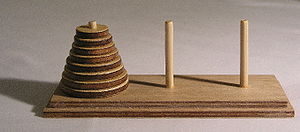
Problem is to move all the rings from first tower into the third tower, one buy one. Here's the catch : you can not ever put a bigger ring on top of a smaller ring. That's why you have been provided with a middle tower, to transit.
Can you solve this your self ? of course you can. (animation at top of the page) All it need is some patience...
Now can we design a computer program to solve this. let's give it a try ....
Hint :
1) Solve it by hand for fewer number of rings and think recursively.
2) Consider three towers as three arrays. One has digits 0 to 9 in that order at start. At the end of the program execution, we need to have all digits in the 3rd array in the proper order.
We will see the answer to this basic version of the problem in the next article by the form of a peace of small, executable code. Remember, we would be upping the ante a bit in the next article and things would get more and more challenging and fun as we go on.....
So, do try it! give it a shot if you haven't already wrote a program to solve this by your self!
Friday, February 18, 2011
Welcome !!
Welcome to our blog!
Here we will discuss and analyze the use of artificial intelligence in gaming, Game Theory, IQ enhancing games and puzzles, AI algorithms used in them etc...
Creating games for PC and smart phones (iphone, android, windows mobile) is our hobby. We intend to share our experience and passion with our readers.
Stay tuned for up coming articles on :
Planet Wars (ai contest from Google) and our experience.
Towers of Hanoi : this is covered in many 1st year CS courses on AI. Here we intend to go little deeper, one step at a time ..
MasterMind : The classic board game.
Dual : An addictive yet simple board and puzzle game developed as a new and own concept.
15 Puzzle : you know it! most simplest of board games out there. or is it ?
and many more.....
If you have interesting thoughts, ideas games and algorithms to share, you are welcome to comment in here.
Here we will discuss and analyze the use of artificial intelligence in gaming, Game Theory, IQ enhancing games and puzzles, AI algorithms used in them etc...
Creating games for PC and smart phones (iphone, android, windows mobile) is our hobby. We intend to share our experience and passion with our readers.
Stay tuned for up coming articles on :
Planet Wars (ai contest from Google) and our experience.
Towers of Hanoi : this is covered in many 1st year CS courses on AI. Here we intend to go little deeper, one step at a time ..
MasterMind : The classic board game.
Dual : An addictive yet simple board and puzzle game developed as a new and own concept.
15 Puzzle : you know it! most simplest of board games out there. or is it ?
and many more.....
If you have interesting thoughts, ideas games and algorithms to share, you are welcome to comment in here.
Subscribe to:
Comments (Atom)