In last post, we planned to discuss more about the problem of multi towers in hanoi and give some hints on the algorithm.
Interestingly, for multiple towers, no one has still come up with a general formula to express the number of steps as a function of number of towers and number of rings. Some general cases have been figured out though. For instance, we don't need to be mathematicians to say whats the number of steps would be for a problem with more towers than there are rings. Say, 11 towers and only 10 rings! what would be the number of steps to solve this ?
Of course, it would take 9 steps to remove top 9 rings into 9 different towers. Then 10 steps to put all rings in the target tower. 19 steps in all. In other words, 2n-1 ! However, people have found that coming up with a general formula when the number of rings are greater than number of towers (which is greater than 3) is little bit harder than that.
In an earlier post we have seen it takes exactly 2n-1 to solve the 3 tower case (worse case) for n rings.
We have just saw that it takes 2n-1 to solve the m tower case for n rings where m > n (best case)
What happens when m =n, Here is my result. I will intentionally leave out the explanations so you can arrive at that independently.
When m = n, it takes (n-1) + 1 + (n-2) + 3 = 2n+1 steps to solve the puzzle!
Similarly, when m = n-1, it becomes 2n+3
It appears like we could express number of steps as (2n-1) + 2*(n-(m+1)) = 4n - 2m + 1
However, these are true only when number of towers are closer to number of rings. When number of towers become less compared to number of rigs, it get complicated. Say, 10 rings in 4 towers. However, solving such a puzzle manually is much easier (in terms of number of steps needed) than solving a similar number of rings with 3 towers. Problem is when we try to find the optimal strategy.
I could display few graphical outputs from the program I currently have but before that, wouldn't you want to give it a try yourself ? Remember, number of steps needed is drastically reduced now. We will still need a recursive solution as the nature of the problem commands....
Tuesday, March 8, 2011

Sunday, February 27, 2011
Bringing Down Towers of Hanoi - part6
Today, we are going to see the magic code which solves Towers of Hanoi General Problem. Those who still (bravely) want to give it an own try before looking at the code. Can go through these hints and do so.
Before going to the code, I have something else to show you. This mathematical proof I found from web, which basically gives a formula for the average number of steps for the general case.

wow, that's some formula for you!
Anyway, as you can see, the code below is the simplicity itself! The solution we propose is bounded by 2n-1, and never exceeds that, also when we present a half done problem, it actually solves it optimally. When you look at the code you get the intuitive feeling that this has to be the optimal solution, wish we could device a mathematical proof too for that fact!
private static void buildTower(int height, ArrayList source,
ArrayList target, ArrayList middle) {
if (height < 0) {
return;
}
if (target.contains(Integer.valueOf(height))) {
buildTower(height -1, source, target, middle);
} else {
if (middle.contains(Integer.valueOf(height))) {
ArrayList temp = middle;
middle = source;
source = temp;
}
buildTower(height-1, source, middle, target);
move(source, target);
print();
buildTower(height-1, middle, target, source);
}
}
Bolded are the lines we added to the last solution. (specific case where all rings are in first tower at the beginning.) Now, isn't this simple ?
One more thing : I havn't yet seen this code (or the algorithm) anywhere in the internet. If some one come across this in anywhere else, please post a comment with the link.
In next post, we will discuss few hints on how to solve the 4 tower case.
Have a nice day!
Before going to the code, I have something else to show you. This mathematical proof I found from web, which basically gives a formula for the average number of steps for the general case.
wow, that's some formula for you!
Anyway, as you can see, the code below is the simplicity itself! The solution we propose is bounded by 2n-1, and never exceeds that, also when we present a half done problem, it actually solves it optimally. When you look at the code you get the intuitive feeling that this has to be the optimal solution, wish we could device a mathematical proof too for that fact!
private static void buildTower(int height, ArrayList
ArrayList
if (height < 0) {
return;
}
if (target.contains(Integer.valueOf(height))) {
buildTower(height -1, source, target, middle);
} else {
if (middle.contains(Integer.valueOf(height))) {
ArrayList
middle = source;
source = temp;
}
buildTower(height-1, source, middle, target);
move(source, target);
print();
buildTower(height-1, middle, target, source);
}
}
Bolded are the lines we added to the last solution. (specific case where all rings are in first tower at the beginning.) Now, isn't this simple ?
One more thing : I havn't yet seen this code (or the algorithm) anywhere in the internet. If some one come across this in anywhere else, please post a comment with the link.
In next post, we will discuss few hints on how to solve the 4 tower case.
Have a nice day!
Saturday, February 26, 2011
Bringing Down Towers of Hanoi - part 5
In the last post, I promised you to give more hints on how to solve (find the algorithm that is) general case of towers of Hanoi. Those who are new to this Hanoi business, can get up to date from earlier parts of the series.
part1
part2
part3
Let's consider the following scenario we have a tower of height 5, instead of having all stacked up neatly in the 1st tower, we have the largest ring already in tower3.
Here's what a run of my code produced.
Step 0 -> 3,2,1,0, : : 4,
Step 1 -> 3,2,1, : 0, : 4,
Step 2 -> 3,2, : 0, : 4,1,
Step 3 -> 3,2, : : 4,1,0,
Step 4 -> 3, : 2, : 4,1,0,
Step 5 -> 3,0, : 2, : 4,1,
Step 6 -> 3,0, : 2,1, : 4,
Step 7 -> 3, : 2,1,0, : 4,
Step 8 -> : 2,1,0, : 4,3,
Step 9 -> : 2,1, : 4,3,0,
Step 10 -> 1, : 2, : 4,3,0,
Step 11 -> 1,0, : 2, : 4,3,
Step 12 -> 1,0, : : 4,3,2,
Step 13 -> 1, : 0, : 4,3,2,
Step 14 -> : 0, : 4,3,2,1,
Step 15 -> : : 4,3,2,1,0,
wow! it found the biggest ring is already in where it wanted to be so finished off with the optimal solution. How do we know that was the optimal ? well, because it took exactly 15 steps, which isthe expected to solve a tower with height 4. Since 5th tile is already there for us, it is like solving a tower of height 4!
Now, then, let's make it little difficult for the computer and see. we pit the biggest ring in the MIDDLE tower at start and let's see what will happen.
Step 0 -> 3,2,1,0, : 4, :
Step 1 -> 3,2,1,0, : : 4,
Step 2 -> 3,2,1, : 0, : 4,
Step 3 -> 3,2, : 0, : 4,1,
Step 4 -> 3,2, : : 4,1,0,
Step 5 -> 3, : 2, : 4,1,0,
Step 6 -> 3,0, : 2, : 4,1,
Step 7 -> 3,0, : 2,1, : 4,
Step 8 -> 3, : 2,1,0, : 4,
Step 9 -> : 2,1,0, : 4,3,
Step 10 -> : 2,1, : 4,3,0,
Step 11 -> 1, : 2, : 4,3,0,
Step 12 -> 1,0, : 2, : 4,3,
Step 13 -> 1,0, : : 4,3,2,
Step 14 -> 1, : 0, : 4,3,2,
Step 15 -> : 0, : 4,3,2,1,
Step 16 -> : : 4,3,2,1,0,
aha! not so difficult again. Code was smart enough to know it should just move the biggest ring to the 3rd tower and it was exactly as the earlier problem.
What if we make things seriously wrong and ask it to solve ? In the normal solution path, after first 3 moves, we should be having the two smallest rings stacked in the middle tower. Let's put them on tower 3 and see.
Step 0 -> 4,3,2, : : 1,0,
Step 1 -> 4,3,2,0, : : 1,
Step 2 -> 4,3,2,0, : 1, :
Step 3 -> 4,3,2, : 1,0, :
Step 4 -> 4,3, : 1,0, : 2,
Step 5 -> 4,3,0, : 1, : 2,
Step 6 -> 4,3,0, : : 2,1,
Step 7 -> 4,3, : : 2,1,0,
Step 8 -> 4, : 3, : 2,1,0,
Step 9 -> 4, : 3,0, : 2,1,
Step 10 -> 4,1, : 3,0, : 2,
Step 11 -> 4,1,0, : 3, : 2,
Step 12 -> 4,1,0, : 3,2, :
Step 13 -> 4,1, : 3,2, : 0,
Step 14 -> 4, : 3,2,1, : 0,
Step 15 -> 4, : 3,2,1,0, :
Step 16 -> : 3,2,1,0, : 4,
Step 17 -> 0, : 3,2,1, : 4,
Step 18 -> 0, : 3,2, : 4,1,
Step 19 -> : 3,2, : 4,1,0,
Step 20 -> 2, : 3, : 4,1,0,
Step 21 -> 2, : 3,0, : 4,1,
Step 22 -> 2,1, : 3,0, : 4,
Step 23 -> 2,1,0, : 3, : 4,
Step 24 -> 2,1,0, : : 4,3,
Step 25 -> 2,1, : : 4,3,0,
Step 26 -> 2, : 1, : 4,3,0,
Step 27 -> 2, : 1,0, : 4,3,
Step 28 -> : 1,0, : 4,3,2,
Step 29 -> 0, : 1, : 4,3,2,
Step 30 -> 0, : : 4,3,2,1,
Step 31 -> : : 4,3,2,1,0,
great! it didn't exceed 31 steps.
Now, can you come up with the code to produce this ? give it a try.... I have a one last hint. Solving is not so difficult. it will only add just few extra lines to the earlier code we have discussed.
Meanwhile, for those who have already come up with the code (but shy to post it to us on comments), we have the next stage of the challenge!
What about 4 Towers ? Solving this is easy when we do it manually and takes lesser number of steps. How about coming up with an algorithm to do that ?
This is a very interesting challenge to contemplate on......
part1
part2
part3
Let's consider the following scenario we have a tower of height 5, instead of having all stacked up neatly in the 1st tower, we have the largest ring already in tower3.
Here's what a run of my code produced.
Step 0 -> 3,2,1,0, : : 4,
Step 1 -> 3,2,1, : 0, : 4,
Step 2 -> 3,2, : 0, : 4,1,
Step 3 -> 3,2, : : 4,1,0,
Step 4 -> 3, : 2, : 4,1,0,
Step 5 -> 3,0, : 2, : 4,1,
Step 6 -> 3,0, : 2,1, : 4,
Step 7 -> 3, : 2,1,0, : 4,
Step 8 -> : 2,1,0, : 4,3,
Step 9 -> : 2,1, : 4,3,0,
Step 10 -> 1, : 2, : 4,3,0,
Step 11 -> 1,0, : 2, : 4,3,
Step 12 -> 1,0, : : 4,3,2,
Step 13 -> 1, : 0, : 4,3,2,
Step 14 -> : 0, : 4,3,2,1,
Step 15 -> : : 4,3,2,1,0,
wow! it found the biggest ring is already in where it wanted to be so finished off with the optimal solution. How do we know that was the optimal ? well, because it took exactly 15 steps, which isthe expected to solve a tower with height 4. Since 5th tile is already there for us, it is like solving a tower of height 4!
Now, then, let's make it little difficult for the computer and see. we pit the biggest ring in the MIDDLE tower at start and let's see what will happen.
Step 0 -> 3,2,1,0, : 4, :
Step 1 -> 3,2,1,0, : : 4,
Step 2 -> 3,2,1, : 0, : 4,
Step 3 -> 3,2, : 0, : 4,1,
Step 4 -> 3,2, : : 4,1,0,
Step 5 -> 3, : 2, : 4,1,0,
Step 6 -> 3,0, : 2, : 4,1,
Step 7 -> 3,0, : 2,1, : 4,
Step 8 -> 3, : 2,1,0, : 4,
Step 9 -> : 2,1,0, : 4,3,
Step 10 -> : 2,1, : 4,3,0,
Step 11 -> 1, : 2, : 4,3,0,
Step 12 -> 1,0, : 2, : 4,3,
Step 13 -> 1,0, : : 4,3,2,
Step 14 -> 1, : 0, : 4,3,2,
Step 15 -> : 0, : 4,3,2,1,
Step 16 -> : : 4,3,2,1,0,
aha! not so difficult again. Code was smart enough to know it should just move the biggest ring to the 3rd tower and it was exactly as the earlier problem.
What if we make things seriously wrong and ask it to solve ? In the normal solution path, after first 3 moves, we should be having the two smallest rings stacked in the middle tower. Let's put them on tower 3 and see.
Step 0 -> 4,3,2, : : 1,0,
Step 1 -> 4,3,2,0, : : 1,
Step 2 -> 4,3,2,0, : 1, :
Step 3 -> 4,3,2, : 1,0, :
Step 4 -> 4,3, : 1,0, : 2,
Step 5 -> 4,3,0, : 1, : 2,
Step 6 -> 4,3,0, : : 2,1,
Step 7 -> 4,3, : : 2,1,0,
Step 8 -> 4, : 3, : 2,1,0,
Step 9 -> 4, : 3,0, : 2,1,
Step 10 -> 4,1, : 3,0, : 2,
Step 11 -> 4,1,0, : 3, : 2,
Step 12 -> 4,1,0, : 3,2, :
Step 13 -> 4,1, : 3,2, : 0,
Step 14 -> 4, : 3,2,1, : 0,
Step 15 -> 4, : 3,2,1,0, :
Step 16 -> : 3,2,1,0, : 4,
Step 17 -> 0, : 3,2,1, : 4,
Step 18 -> 0, : 3,2, : 4,1,
Step 19 -> : 3,2, : 4,1,0,
Step 20 -> 2, : 3, : 4,1,0,
Step 21 -> 2, : 3,0, : 4,1,
Step 22 -> 2,1, : 3,0, : 4,
Step 23 -> 2,1,0, : 3, : 4,
Step 24 -> 2,1,0, : : 4,3,
Step 25 -> 2,1, : : 4,3,0,
Step 26 -> 2, : 1, : 4,3,0,
Step 27 -> 2, : 1,0, : 4,3,
Step 28 -> : 1,0, : 4,3,2,
Step 29 -> 0, : 1, : 4,3,2,
Step 30 -> 0, : : 4,3,2,1,
Step 31 -> : : 4,3,2,1,0,
great! it didn't exceed 31 steps.
Now, can you come up with the code to produce this ? give it a try.... I have a one last hint. Solving is not so difficult. it will only add just few extra lines to the earlier code we have discussed.
Meanwhile, for those who have already come up with the code (but shy to post it to us on comments), we have the next stage of the challenge!
What about 4 Towers ? Solving this is easy when we do it manually and takes lesser number of steps. How about coming up with an algorithm to do that ?
This is a very interesting challenge to contemplate on......
Wednesday, February 23, 2011
Bringing Down Towers of Hanoi - part4

In last post, we wondered what on earth the number 2n-1 doing (regardless of how many N rings we used!) in our little towers problem, for all the values of N.
1) make a tower N-1 on the transit tower
2) move ring N from source to the final destination
3) make a tower N-1 on final destination
That involved 2 towers with height N-1 and moving of one ring. Similarly making a tower of N-1 will be equal to making 2 towers of N-2 and moving a ring. if we expand this for 3 ring case:
tower of 3 = 2 * (tower of 2) + 1 = 2 * (2*(tower of 1) +1) + 1 = 2 * (2*(1) +1) + 1 = 7 = 23 - 1
(since making a tower of 1 always takes one move)
so, making a tower of 3 involved making 2 towers of 2 and 1 move.
that is, 4 towers of 1 and 2 + 1 moves.
that is, 2(3-1) towers of 1 and 21 + 20 moves. (making a tower of 1 takes just 1 move)
that is, 2n-1 + (2n-2 + 2n-3 + 2n-4 + ... + 20)
Total Steps = 2n-1 + (2n-2 + 2n-3 + 2n-4 + ... + 1)
but the sum of sequence (2n-2 + 2n-3 + 2n-4 + ... + 1) = 2n-1 - 1
Hence total steps = 2n-1 + 2n-1 - 1 = 2 * (2n-1 ) - 1 = 2n-1 !!
Wow, now we know why it has to be 2n-1 always !!
Our series is only just starting to get interesting! Now to the today's challenge :
We can now write a nice recursive function to solve the puzzle. However, what we are solving is actually a subset of the problem. We have so far considered cases where all the rings are in tower 1. How about we removing that restriction, how about letting the rings to be anywhere on 3 towers (as long as a bigger ring is not upon a smaller). Can we come up with the code to resolve that ?
In fact, this can be considered as the general case in Towers of Hanoi. What we have discussed in earlier posts was just a specific subset of it. In the next post, we will come with few more hits on how to approach that.
Meanwhile, try it out yoursef!
Tuesday, February 22, 2011
Bringing Down Towers of Hanoi - part3
Today, we will see the code to solve Towers of Hanoi. A simple recursive function which does following... (If we have 10 rings, N would be 10)
1) build a tower of height N-1 on tower2 (from tower1)
2) move the ring N from tower1 into tower3
3) build a tower of height N-1 (again) but this time on top of tower3 (from tower2)
but we have to do it recursive for N-1 (that is 9) too then also for 8 etc .. For those who are new to the series or like to give another attempt to write the code on their own, you can visit here and here for details and motivation.
The Complete Java code can be found at the end of this post. (it would be straightforward to write this in any other language) You can run it passing the number of rings as a parameter for the main method. ie : java HanoiTowers 5 and it will display the proceedings in a text base command line display.
This is the output I got for 5 rings :
Step 0 -> 4,3,2,1,0, : :
Step 1 -> 4,3,2,1, : : 0,
Step 2 -> 4,3,2, : 1, : 0,
Step 3 -> 4,3,2, : 1,0, :
Step 4 -> 4,3, : 1,0, : 2,
Step 5 -> 4,3,0, : 1, : 2,
Step 6 -> 4,3,0, : : 2,1,
Step 7 -> 4,3, : : 2,1,0,
Step 8 -> 4, : 3, : 2,1,0,
Step 9 -> 4, : 3,0, : 2,1,
Step 10 -> 4,1, : 3,0, : 2,
Step 11 -> 4,1,0, : 3, : 2,
Step 12 -> 4,1,0, : 3,2, :
Step 13 -> 4,1, : 3,2, : 0,
Step 14 -> 4, : 3,2,1, : 0,
Step 15 -> 4, : 3,2,1,0, :
Step 16 -> : 3,2,1,0, : 4,
Step 17 -> 0, : 3,2,1, : 4,
Step 18 -> 0, : 3,2, : 4,1,
Step 19 -> : 3,2, : 4,1,0,
Step 20 -> 2, : 3, : 4,1,0,
Step 21 -> 2, : 3,0, : 4,1,
Step 22 -> 2,1, : 3,0, : 4,
Step 23 -> 2,1,0, : 3, : 4,
Step 24 -> 2,1,0, : : 4,3,
Step 25 -> 2,1, : : 4,3,0,
Step 26 -> 2, : 1, : 4,3,0,
Step 27 -> 2, : 1,0, : 4,3,
Step 28 -> : 1,0, : 4,3,2,
Step 29 -> 0, : 1, : 4,3,2,
Step 30 -> 0, : : 4,3,2,1,
Step 31 -> : : 4,3,2,1,0,
Step 0 above was the starting state of 3 towers (separated by ":" s). To solve the entire problem, it took only 4 lines of code!
source, ArrayList target, ArrayList middle) {
if (height < 0) return;
buildTower(height-1, source, middle, target);
move(source, target); // just moves the top ring from source into top of target
buildTower(height-1, middle, target, source);
}
That was all which took for solving the whole puzzle, Now, that's the power of recursion!
Now to the second part of the challenge : The puzzle above took exactly 31 moves. Similarly you would see puzzle with 10 will take 1023. 4 rings will take 15. N rings will take exactly
How did that happen ? can we explain how on earth the value 2n - 1 comes in for all values of N ? what is the significance of 2 there ? Try to figure it out, we will discuss the explanation in the next post.
Meanwhile...
Following is the complete Java code for today's post. Enjoy!
}
1) build a tower of height N-1 on tower2 (from tower1)
2) move the ring N from tower1 into tower3
3) build a tower of height N-1 (again) but this time on top of tower3 (from tower2)
but we have to do it recursive for N-1 (that is 9) too then also for 8 etc .. For those who are new to the series or like to give another attempt to write the code on their own, you can visit here and here for details and motivation.
The Complete Java code can be found at the end of this post. (it would be straightforward to write this in any other language)
This is the output I got for 5 rings :
Step 0 -> 4,3,2,1,0, : :
Step 1 -> 4,3,2,1, : : 0,
Step 2 -> 4,3,2, : 1, : 0,
Step 3 -> 4,3,2, : 1,0, :
Step 4 -> 4,3, : 1,0, : 2,
Step 5 -> 4,3,0, : 1, : 2,
Step 6 -> 4,3,0, : : 2,1,
Step 7 -> 4,3, : : 2,1,0,
Step 8 -> 4, : 3, : 2,1,0,
Step 9 -> 4, : 3,0, : 2,1,
Step 10 -> 4,1, : 3,0, : 2,
Step 11 -> 4,1,0, : 3, : 2,
Step 12 -> 4,1,0, : 3,2, :
Step 13 -> 4,1, : 3,2, : 0,
Step 14 -> 4, : 3,2,1, : 0,
Step 15 -> 4, : 3,2,1,0, :
Step 16 -> : 3,2,1,0, : 4,
Step 17 -> 0, : 3,2,1, : 4,
Step 18 -> 0, : 3,2, : 4,1,
Step 19 -> : 3,2, : 4,1,0,
Step 20 -> 2, : 3, : 4,1,0,
Step 21 -> 2, : 3,0, : 4,1,
Step 22 -> 2,1, : 3,0, : 4,
Step 23 -> 2,1,0, : 3, : 4,
Step 24 -> 2,1,0, : : 4,3,
Step 25 -> 2,1, : : 4,3,0,
Step 26 -> 2, : 1, : 4,3,0,
Step 27 -> 2, : 1,0, : 4,3,
Step 28 -> : 1,0, : 4,3,2,
Step 29 -> 0, : 1, : 4,3,2,
Step 30 -> 0, : : 4,3,2,1,
Step 31 -> : : 4,3,2,1,0,
Step 0 above was the starting state of 3 towers (separated by ":" s). To solve the entire problem, it took only 4 lines of code!
if (height < 0) return;
buildTower(height-1, source, middle, target);
move(source, target); // just moves the top ring from source into top of target
buildTower(height-1, middle, target, source);
}
That was all which took for solving the whole puzzle, Now, that's the power of recursion!
How did that happen ? can we explain how on earth the value 2n - 1 comes in for all values of N ? what is the significance of 2 there ? Try to figure it out, we will discuss the explanation in the next post.
Meanwhile...
Following is the complete Java code for today's post. Enjoy!
package com.araaya.hanoitowers;
import java.util.ArrayList;
/**
*@author Ashoka Ekanayaka
* www.it-front.net, www.araaya.com
*/
public class HanoiTowers {
static ArrayList source1, target1, middle1;
static int steps = -1;
public static void main(String[] args) {
int height = Integer.parseInt(args[0]);
source1 = new ArrayList(height);
target1 = new ArrayList(height);
middle1 = new ArrayList(height);
for (int i=height-1; i >= 0; i--) {
source1.add(i);
}
print();
buildTower(height-1, source1, target1, middle1);
}
private static void buildTower(int height, ArrayList source, ArrayList target,
ArrayList middle) {
ArrayList
if (height < 0) return;
buildTower(height-1, source, middle, target);
buildTower(height-1, source, middle, target);
move(source, target);
print();
buildTower(height-1, middle, target, source);
}
private static void print() {
steps++;
System.out.print("Step " + steps + " -> ");
for (Integer i : source1) {
System.out.print(i+",");
}
System.out.print(" : ");
for (Integer i : middle1) {
System.out.print(i+",");
}
System.out.print(" : ");
for (Integer i : target1) {
System.out.print(i+",");
}
System.out.println();
}
private static void move(ArrayList source, ArrayList target) {
target.add(source.get(source.size()-1)); // move top element in source to top of target
source.remove(source.size()-1);
}
}
Bringing Down Towers of Hanoi - part2
Ok, Here we would discuss the solution and the code to implement it for our little tower puzzle. Those who are new to the series or those who like to give one last try at the puzzle before looking at the answer. Can do so by going back to part1.
Let's imagine we have a simple tower of 5 rings.
 To move the rings in first tower to 3rd tower, we need to move the larger ring to 3rd tower first since we can not place it above any other rings. (remember the rule : there can never be a larger ring on top of a smaller one) However, to move the largest ring from tower 1, we need to move all the other out of it first so that we can lift it. At the same time we have to keep the tower1 empty so that we can put the largest ring there. That means we need to have this position.
 Aha! now we can move the largest ring to tower3, then we will have to build a tower from 1-4 on top of tower 3 to complete the puzzle.
In other words, to build a tower of height N on tower3 (from tower1), we need to :
1) build a tower of height N-1 on tower2 (from tower1)
2) move the ring N from tower1 into tower3
3) build a tower of height N-1 (again) but this time on top of tower3 (from tower2)
Let's go back to the diagram where we have cleared tower1 to lift the largest ring (5th ring) :
To lift that, we had to create a tower of 1-4 on tower2, but to do that we need to move the ring 4 into tower2, this means we need to remove rings 1-3 from tower 1 first so that we can move ring4 into the middle one...

Hmm, so we needed to build a tower 1-3 on tower3 in order to move 4 into tower2! (in order to move ring 5 to the ultimate goal, tower3) Similarly, we would first have to build a tower 1-2 on tower2 to move the ring3 to tower3. To do that, we need to move 1 into tower3 so that we can move 2 into tower 2. So our first move should be :

Thus, moving the smallest ring to tower2 as the first move will be wrong! ring1 has to be on tower 3 because : (hold your breadth now, see whether you can follow this in your head till the end)
We needed to move 2 into tower2 (to build 1-2 on tower2), that was because
We needed to move 3 into tower3 (to build 1-3 on tower3), that was because
We needed to move 4 into tower2 (to build 1-4 on tower2), that was because
We needed to move 5 into tower3 (to build1-5 on tower3), that was because
It was the end goal of the puzzle!
Simple isn't it ? Solving the case of 10 rings would have the exact same logic. There we will have to move ring 1 into tower2 as our first move. (follow the same logic in your mind for 10 steps and you will see why)
Now to the code. Earlier we deduced that,
Building a tower of height N on tower3 (from tower1), is as same as saying :
1) build a tower of height N-1 on tower2 (from tower1)
2) move the ring N from tower1 into tower3
3) build a tower of height N-1 (again) but this time on top of tower3 (from tower2)
that included building a tower of N-1 on tower2, but in the same logic, we can define building a tower of N-1 as :
1) build a tower of height N-2 on tower3 (from tower1)
2) move the ring N-1 from tower1 into tower2
3) build a tower of height N-2 (again) but this time on top of tower2 (from tower3)
and so on until we build a tower of 1. Now, can write the small little recursive function to solve the entire puzzle?
Hint : it has only 3 lines.
In the next post, we will see the code and we will also investigate why that it always take 2n - 1 steps to solve a Tower of Hanoi problem with N rings.
Challenge 1 : write the code to solve Towers of Hanoi puzzle for a given N.
Challenge 2 : in the above solving algorithm, prove that it always takes exactly 2n - 1 steps to solve the puzzle.
Let's imagine we have a simple tower of 5 rings.
 To move the rings in first tower to 3rd tower, we need to move the larger ring to 3rd tower first since we can not place it above any other rings. (remember the rule : there can never be a larger ring on top of a smaller one) However, to move the largest ring from tower 1, we need to move all the other out of it first so that we can lift it. At the same time we have to keep the tower1 empty so that we can put the largest ring there. That means we need to have this position.
 Aha! now we can move the largest ring to tower3, then we will have to build a tower from 1-4 on top of tower 3 to complete the puzzle.
In other words, to build a tower of height N on tower3 (from tower1), we need to :
1) build a tower of height N-1 on tower2 (from tower1)
2) move the ring N from tower1 into tower3
3) build a tower of height N-1 (again) but this time on top of tower3 (from tower2)
Let's go back to the diagram where we have cleared tower1 to lift the largest ring (5th ring) :
To lift that, we had to create a tower of 1-4 on tower2, but to do that we need to move the ring 4 into tower2, this means we need to remove rings 1-3 from tower 1 first so that we can move ring4 into the middle one...

Hmm, so we needed to build a tower 1-3 on tower3 in order to move 4 into tower2! (in order to move ring 5 to the ultimate goal, tower3) Similarly, we would first have to build a tower 1-2 on tower2 to move the ring3 to tower3. To do that, we need to move 1 into tower3 so that we can move 2 into tower 2. So our first move should be :

Thus, moving the smallest ring to tower2 as the first move will be wrong! ring1 has to be on tower 3 because : (hold your breadth now, see whether you can follow this in your head till the end)
We needed to move 2 into tower2 (to build 1-2 on tower2), that was because
We needed to move 3 into tower3 (to build 1-3 on tower3), that was because
We needed to move 4 into tower2 (to build 1-4 on tower2), that was because
We needed to move 5 into tower3 (to build1-5 on tower3), that was because
It was the end goal of the puzzle!
Simple isn't it ? Solving the case of 10 rings would have the exact same logic. There we will have to move ring 1 into tower2 as our first move. (follow the same logic in your mind for 10 steps and you will see why)
Now to the code. Earlier we deduced that,
Building a tower of height N on tower3 (from tower1), is as same as saying :
1) build a tower of height N-1 on tower2 (from tower1)
2) move the ring N from tower1 into tower3
3) build a tower of height N-1 (again) but this time on top of tower3 (from tower2)
that included building a tower of N-1 on tower2, but in the same logic, we can define building a tower of N-1 as :
1) build a tower of height N-2 on tower3 (from tower1)
2) move the ring N-1 from tower1 into tower2
3) build a tower of height N-2 (again) but this time on top of tower2 (from tower3)
and so on until we build a tower of 1. Now, can write the small little recursive function to solve the entire puzzle?
Hint : it has only 3 lines.
In the next post, we will see the code and we will also investigate why that it always take 2n - 1 steps to solve a Tower of Hanoi problem with N rings.
Challenge 1 : write the code to solve Towers of Hanoi puzzle for a given N.
Challenge 2 : in the above solving algorithm, prove that it always takes exactly 2n - 1 steps to solve the puzzle.
Bringing Down Towers of Hanoi - part1

Hope this post will not bring as much destruction as it's title suggests. In fact, we are not interested in bringing down any single tower in Hanoi, not even in any where else for that matter. What we would be doing is to brining down the problem of Towers of Hanoi into the levels we can understand it. Of course, if that was the title, we wouldn't probably be in here reading this right now would we ?
Towers of Hanoi is a popular puzzle, first introduced by the French mathematician Édouard Lucas in 1883. (However, some do maintain that the puzzle is much older than that) Those who are not familiar with the puzzle can learn all about it from here. There is a particular interest on this puzzle by the hacker (programmer, developer, coder) community mainly due to the fact that it has been taught in many 1st year CS courses throughout the world. The puzzle is a great example to demonstrate the power of recursion.
However, Towers of Hanoi is a deep enough problem that one can do it for a PhD. It could go many levels in depth and complexity. The most simplest version, I guess most of our readers have already studied in first year. Let's approach the problem step by step. If you are not a programmer and/or haven't done this problem before consider yourself lucky! you got an opportunity to have a fresh look at a very interesting problem and reap all the satisfaction of finding the solution on your own! Oh boy, this series gonna be a bit longer one....
Ready to jump in ? Ok, let's bring them down then!
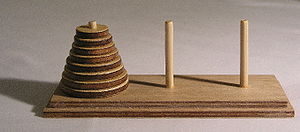
Problem is to move all the rings from first tower into the third tower, one buy one. Here's the catch : you can not ever put a bigger ring on top of a smaller ring. That's why you have been provided with a middle tower, to transit.
Can you solve this your self ? of course you can. (animation at top of the page) All it need is some patience...
Now can we design a computer program to solve this. let's give it a try ....
Hint :
1) Solve it by hand for fewer number of rings and think recursively.
2) Consider three towers as three arrays. One has digits 0 to 9 in that order at start. At the end of the program execution, we need to have all digits in the 3rd array in the proper order.
We will see the answer to this basic version of the problem in the next article by the form of a peace of small, executable code. Remember, we would be upping the ante a bit in the next article and things would get more and more challenging and fun as we go on.....
So, do try it! give it a shot if you haven't already wrote a program to solve this by your self!
Subscribe to:
Comments (Atom)